
The 2026 Kelowna Reset: How the Convergence of New Roads, Rental Rules, and Interest Rates Will Redefine Your Property Value
Discover how Kelowna's 2026 rental market shifts, new infrastructure projects, and interest rate trends will impact property values. Learn which neighborhoods offer the best opportunities as STR regulations evolve and major road extensions reshape accessibility across the city.

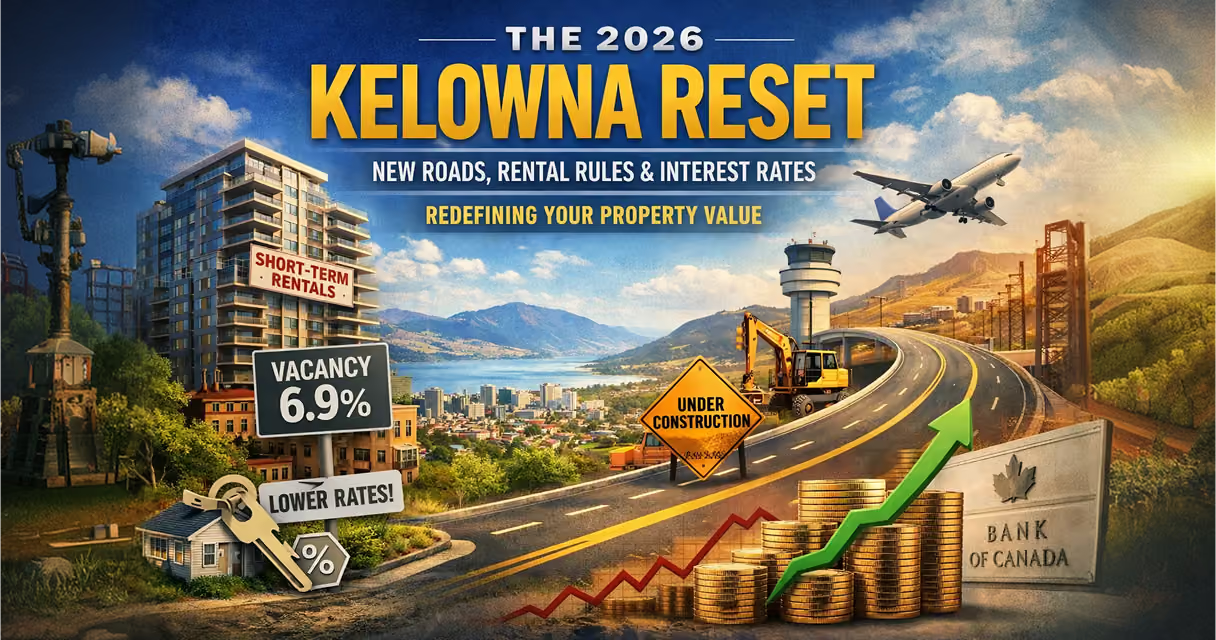
If you’ve been scanning the headlines lately, you’re likely seeing a lot of mixed signals. One day, you read that rental vacancy is at a historic high; the next, you hear about a housing shortage. You see interest rates holding steady, yet infrastructure projects are booming all around us.
It’s confusing, and quite frankly, it’s a lot of noise. But if you look past the headlines, 2026 is shaping up to be a year of selective opportunity.
I’ve spent the winter analyzing the minutes from City Council and the latest Bank of Canada forecasts so you don’t have to. Here is the signal through the noise, and what the "2026 Reset" means for your home and your portfolio.
1. The Rental Paradox: Why the "Glut" is actually an Opportunity
For over a decade, Kelowna was defined by scarcity. We all remember the days of near-zero vacancy rates. In a dramatic shift, the Greater Kelowna area is now reporting a rental vacancy rate of 6.3%, with the City of Kelowna itself hitting 6.9%.
This surge is largely due to a wave of over 3,000 purpose-built rental units completing just as migration patterns shifted. For the casual investor, this is a warning sign: the days of buying a shoebox condo and effortlessly finding a tenant are paused.
But here is the pivot: The provincial legislation that restricted Short-Term Rentals (STRs) contained a specific "opt-out" clause. If a municipality’s vacancy rate exceeds 3% for two consecutive years, it can request to exempt itself from the principal residence requirement.
Kelowna now meets this criteria. City Council is actively working to reinstate STRs to support our tourism economy, specifically targeting a "hybrid" model that may allow rentals in specific buildings—likely those with 70+ units or commercial zoning. While the standard process would delay this until November 2026, there is significant pressure, including proposed legislation by MLA Gavin Dew, to move this date to May 1st to save the summer season.
If the opt-out is fast-tracked, specific condos in STR-friendly buildings could see an immediate value spike this spring.
2. Paving the Way to Value: The Infrastructure Effect
Real estate values are often determined by what I call "drivability." In 2026, we are seeing the mobilization of the Transportation Accelerator Program (TAP), which is fast-tracking key projects.
- The Burtch Road Extension: Work is slated to begin in March 2026 to extend Burtch Road from Denver to K.L.O. Road. This creates a vital north-south spine that will relieve pressure on Gordon and Benvoulin. For homeowners in the Lower Mission and South Central Kelowna, this improves connectivity significantly.
- Hollywood Road North: Upgrades here are critical for connecting Rutland to UBCO and the Airport.
Smart buyers look for the "path of progress." Properties that were previously considered "too far" or "too congested" are about to get a major location score upgrade.
And while nobody likes a tax hike, it is worth noting that Kelowna’s proposed 2026 tax increase of 4.37% is focused heavily on safety and infrastructure. When you compare this to West Kelowna’s proposed 7.6% increase, our market remains comparatively efficient for homeowners.
3. The Interest Rate Window: Marry the House, Date the Rate
The consensus among major financial institutions is that the Bank of Canada will likely hold its policy rate at 2.25% through most of 2026.
However, the "sweet spot" for buyers appears to be early in the year. Forecasts suggest 5-year fixed mortgage rates could dip into the 3.8% - 4.2% range in Q1 and Q2 before potentially creeping back up later in the year.
With the rental glut softening asking prices in some segments, early 2026 offers a unique window of manageable fixed rates combined with negotiated purchase prices.
4. Families and Features: What Matters Now
If you are buying for your family, double-check your school catchments. School District 23 has approved boundary adjustments for Webber Road and Shannon Lake Elementary for the 2026 school year.
On the design front, we are seeing a shift away from the "flipped" look. The 2026 aesthetic is about warmth—think "Color Drenching" and "Neo Deco" rather than sterile white-on-white. More importantly, buyers are prioritizing resilience. Features like "FireSmart" landscaping are transitioning from a nice-to-have to an insurability requirement.
Conclusion
2026 is not a "business as usual" year. It is a year of new roads, new rules, and new rates.
If you are thinking of making a move, let’s sit down and look at how these macro changes affect your specific neighbourhood. Whether you are eyeing a bungalow in Gallagher’s or an investment condo downtown, you need a strategy that sees around corners.